Get to know the Ribeira Sacra
The Ribeira Sacra stretches from Portomarín to Ourense along the River Miño, and at Os Peares it joins the River Sil coming from Petín — a journey of 80 km.
Almost the entire length of both rivers is devoted to viticulture, making use of the river slopes for planting vines and thus capturing more sunlight.
It is expected that next year the Ribeira Sacra will be designated a UNESCO World Heritage Site.
Almost everyone in the area has vineyards, large or small, for their own consumption. Galicia has six wine denominations of origin with a production of 777,123 hectolitres. As a whole, Galicia is the region with the most wineries, with 500 — well ahead of other regions, with Castilla-La Mancha being the closest competitor at 397 wineries.
Catamaran Trips
One of the great attractions of the Ribeira Sacra is the catamaran trips along the rivers. There are two catamaran routes: one departing from Belesar along the Os Peares reservoir on the River Miño, and another departing from the San Esteban jetty in Nogueira de Ramuín, on the River Sil.
The Wine Route
The Wine Route is one of the region's greatest treasures. If you visit the Ribeira Sacra, you should try at least part of the route. This wine trail covers the entire Ribeira Sacra Denomination of Origin and includes approximately 20 municipalities stretching from the south of the province of Lugo to the north-eastern part of the province of Ourense.
The municipalities covered by this designation of origin are Portomarín, Paradela, O Saviñao, Pantón, Monforte de Lemos, A Pobra do Brollón, Quiroga, Ribas do Sil, Taboada, Chantada, Sober and Carballedo in the province of Lugo; as well as A Peroxa, A Pobra de Trives, Manzaneda, A Teixeira, Castro Caldelas, Parada do Sil, San Xoán de Río and Nogueira de Ramuín in the province of Ourense.
The Landscape of the Ribeira Sacra
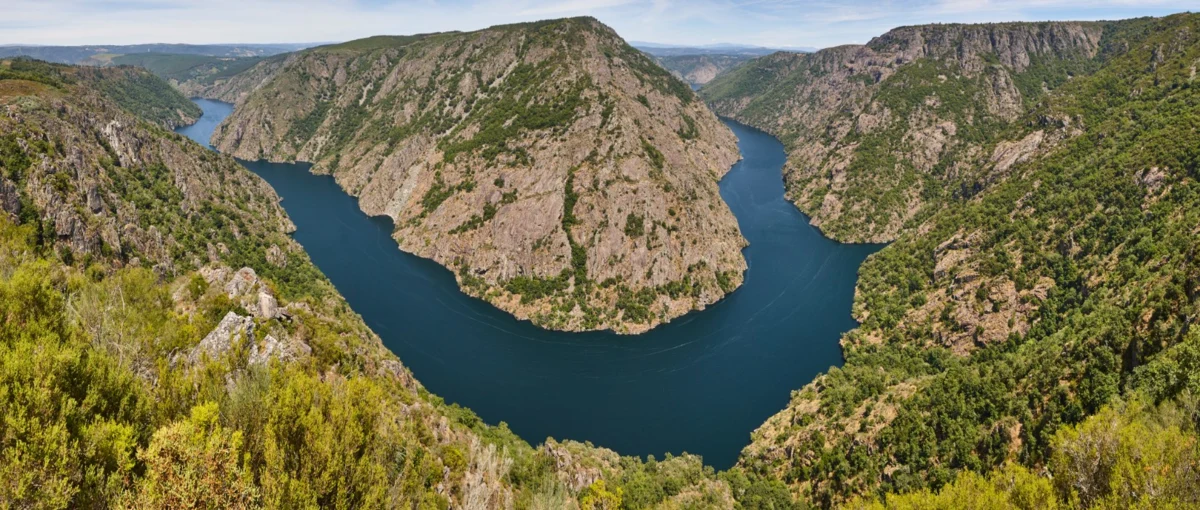
The area is divided by the Miño and Sil rivers, dotted with small streams and waterfalls that add to the beauty of the landscape.
The terraced vineyards on the hillsides, the spectacular river gorges and the countless monasteries and churches scattered throughout the region gave rise to the name Ribeira Sacra, meaning banks of the sacred river.
The diversity of the landscape is extraordinary: vineyards stretching alongside local oak and chestnut forests, and mountainous areas such as Cabeza de Manzaneda and El Faro.